Wednesday, March 16, 2016

March 12, 1972: First Ever Philippine Made Rocket Launched- How TRUE?!

The Bongbong Rocket. Photo courtesy of Mitch Romero thru Youtube.
The first ever Philippine made rocket named "Bongbong I" was reportedly launched at Caballo island near Corrigedor in the Manila Bay on March 12, 1972 allegedly followed by several more tests in the succeeding months at the island. The rocket was named after the second child and first son of President Marcos- Bongbong Marcos. This was under the Philippine Navy Project Santa Barbara which was the local Rocket Program initiated under then President Ferdinand E. Marcos in the 1970s. 

On March 12, 1972, a Philippine made rocket named "Bongbong I" reportedly launched 
at Caballo island near Corrigedor in the Manila Bay and retrieved from the South China Sea. 
It was a Rocket program which used an artillery with no guidance system involved- a technology that has long been in use around the world way before the 1970s. This was supposed to be a part of the Philippine Military experiment to produce its own ballistic missiles  researched and developed by a group of Filipino and German engineers and scientists.

The Bukang Liwayway Rocket Launcher. Photo courtesy of mitch romero thru Youtube.
The following year, the rockets were featured during the 1973 Independence Day Parade at the Luneta Grandstand (see video below).


According to reports, the missile tested were of different configurations of a 180 MM liquid-propellant rocket: short version with fixed fins, long version with fixed fins, long version with folding fins, and the Pressure Assisted Take Off type. The launchers tested were the Fixed-Open Frame (short), Fixed-Open frame (long), Truck-mounted tube launcher, truck-mounted open frame, and the Submerged Launcher for underwater firing.

Notes and Controversy: 
- Evidences for these rockets are found only on a few news articles and still pictures like the ones posted here. Only one video was known to exist with only one public demonstration known to have been made.
– No videos of the launches are known to exist which puts into doubt IF the program was successful and if the Program itself was used mainly for Propaganda purposes,
–  The rockets were never mass produced. No surviving samples of the Bongbong and SB110 rockets nor of the Bukang Liwayway Rocket Launchers are known to exist.
Front view of the locally made Sumpak Rocket Launcher. Photo courtesy of Wikimedia Commons.

– The only surviving sample of the program is the Sumpak launcher . This launcher was originally named “Mk 40 Mobile Assault Rocket Combat Operational System (MARCOS)” but was later changed to “Sumpak” (Filipino for “Blowgun” “Improvised Gun”). Note that it does NOT use locally made rockets.

Project Santa Barbara was discontinued after the Marcos administration.


technorati tags:

del.icio.us tags:

keotag tags:

Tuesday, March 15, 2016

1903 Kennon Road Construction.

Benguet Road construction crew near Camp 5, Tuba, Benguet ca1903 setting explosives into a sheer cliff of the Bued River Canyon.

''Kennon Road''' (formerly the '''Benguet Road''' and also known as the '''Rosario–Baguio Road''') is a roadway in Benguet provincein the Philippines connecting the mountain city of Baguio to the lowland towns of Rosario and Pugo in La Union province. The project was begun in 1903 and opened for travel on January 29, 1905. It was originally called the Benguet Road and later renamed in honor of its builder, Col. Lyman Walter Vere Kennon of the U.S. Army Corps of Engineers
Lyman W.V. Kennon-1917
For travelers coming from Manila or the provinces in the central plains of Luzon, it is the shortest route to Baguio.

Vintage vehicles on their way up to Baguio City. Kennon Road was then known as Benguet Road.

Tuesday, February 16, 2016

September 8, 1929: First Igorot Beauty Contest!


According to this picture found on line (from Facebook Group Memories of Old Manila), on September 8, 1929 the first Igorot beauty contest was held at old capitol of Mountain Province....The handwritten caption reads:

"The first Igorot beauty contest held at Bontoc (Capital of Old Mountain Province) September 8, 1929. They belong to different ethnic tribes of the Cordillera including the Bago people of the Ilocos Sur."

True or not about the the picture and the "first Igorot beauty contest" caption, it is true that Bagos are the hill tribe dwellers and original inhabitants in the border regions between Ilocos and Cordillera mountains different from their neighboring tribes and other adjacent ethnic groups whose ancestors are early inhabitants of the country prior to colonization.

Tuesday, February 9, 2016

February 9, 1945-Battle for Manila: US Troops Retake Far Eastern University!


Battle for Manila.  February 9, 1945.  American troops successfully retake Far Eastern University and advancing to the south of Pasig River. FEU was a garrison during Japanese occupation and heavy gunbattle ensued to liberate the campus and the Japanese massacred all their captives including FEU founder Nicanor Reyes Sr. and some members of his family.  Josefa Llanes Escoda - founder of Girl Scout was brutally tortured and killed inside the campus.
Remembering Liberation and the death of the FEU founder


Wednesday, February 3, 2016

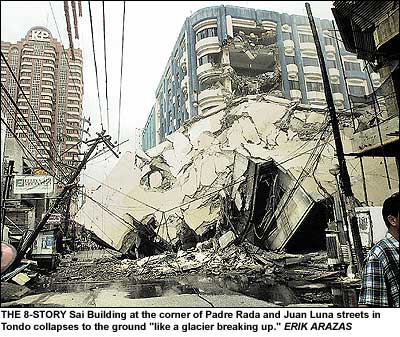
July 23, 2004- Collapse of the "Leaning Tower" of Divisoria!


building collapsed in Divisoria the famous Manila’s classic bargain street-shopping district. The building owner claimed that the collapse was caused by multiple excavations in lots adjacent to the property. 

See actual video below!


Fortunately, the occupants of the ill fated building were forewarned when the whole structure started leaning over earlier the same morning, so no one was hurt — except for a city administrator whose knee was injured in the stampede of kibitzers running from the scene as the structure fell into the building across the street.


February 4, 1945: US 37th Infantry Division troops Crosses Pasig River!

37th Infantry Division troops crossing the Pasig River in 

Manila4 February 1945U.S. National Archives

The Battle for Manila from 3 February to 3 March 1945, fought by U.S. and Japanese forces, was part of the Philippines' 1945 campaign. The one-month battle which culminated in a terrible bloodbath and total devastation of the city was the scene of the worst urban fighting in the Pacific War|Pacific theater, ended almost three years, 1942-1945 of Japanese military occupation in the Philippines. The city's capture was marked as General Douglas MacArthur's key to victory in the campaign of reconquest.

By 4 February, the rapid drive to Manila by U.S. forces began. Using intelligence provided by Filipino guerrillas, American units were able to find intact bridges and shallow rivers everywhere they went.